Remittances to India by Country, 2016-2024
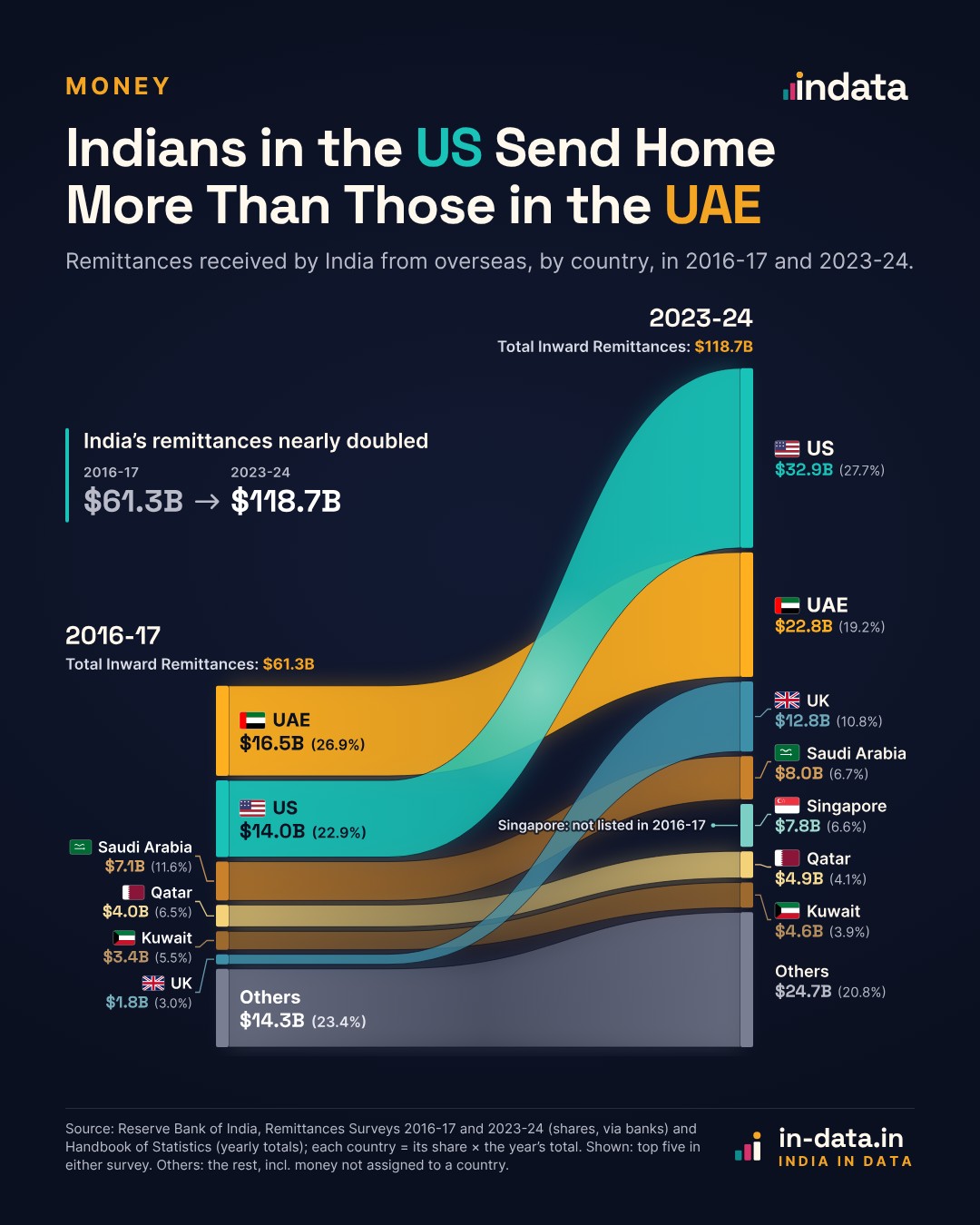
This graphic shows remittances to India by country in 2016-17 and 2023-24: how much money Indians abroad sent home from each country, in US dollars.
Key takeawayIndians in the United States sent home about $32.9 billion in 2023-24, more than the $22.8 billion sent from the United Arab Emirates, which was the biggest source in 2016-17.
More than 18 million Indian migrants live overseas, and each year, they send home billions of dollars in remittances.
Over the years, both the number of migrants and the money they send home have grown significantly. The countries that they send money from have changed too, with the United States (US) overtaking the United Arab Emirates (UAE) as India’s single largest source of remittances.
This graphic compares inward remittances to India by country between 2016-17 and 2023-24, using the Reserve Bank of India’s (RBI) surveys of remittances.
Remittances to India by Country
In 2016-17, Indians in the UAE sent home the most, about $16.5 billion, ahead of the $14.0 billion from the United States. By 2023-24 the order had flipped. The United States sent about $32.9 billion, more than a quarter of the total, and the UAE about $22.8 billion.
The table below shows the money sent from each country in both years, and its share of India’s total:
| Sending country | 2016-17 | 2023-24 | Share, 2016-17 | Share, 2023-24 |
|---|---|---|---|---|
| United States | $14.0 billion | $32.9 billion | 22.9% | 27.7% |
| United Arab Emirates | $16.5 billion | $22.8 billion | 26.9% | 19.2% |
| United Kingdom | $1.8 billion | $12.8 billion | 3.0% | 10.8% |
| Saudi Arabia | $7.1 billion | $8.0 billion | 11.6% | 6.7% |
| Singapore | Not listed | $7.8 billion | Not listed | 6.6% |
| Qatar | $4.0 billion | $4.9 billion | 6.5% | 4.1% |
| Kuwait | $3.4 billion | $4.6 billion | 5.5% | 3.9% |
| Others | $14.3 billion | $24.7 billion | 23.4% | 20.8% |
Money from the UAE did not fall. It grew by more than a third. But money from the United States more than doubled, and money from the United Kingdom (UK) rose from about $1.8 billion to $12.8 billion.
Why the Sources Shifted
The Gulf used to dominate. In 2016-17, the Gulf countries together sent more than half of India’s remittances. In 2023-24, the six Gulf countries sent 37.9%, while five advanced economies (the United States, the United Kingdom, Singapore, Canada and Australia) sent more than half.
The RBI’s explanation is the kind of work Indians do abroad. Those in the United States mostly hold skilled, white-collar jobs. Most Indian workers in the UAE are in blue-collar jobs, mainly construction, then healthcare, hospitality and tourism. So the United States, with fewer Indian migrants than the UAE, still sends more money.
India has been the world’s top recipient of remittances since 2008, according to the World Bank. Within India, most of the money lands in three states: Maharashtra (20.5%), Kerala (19.7%) and Tamil Nadu (10.4%).
Source and method
Reserve Bank of India, India’s Remittances Survey: for 2023-24, RBI Bulletin, March 2025 (Table 1); for 2016-17, RBI Bulletin, November 2018 (Chart 1). The surveys give each country’s share of remittances received through banks. Yearly totals are private transfer receipts from the RBI’s Handbook of Statistics on the Indian Economy, Table 130. Dollar values are our calculation: each country’s share applied to that year’s total. The graphic shows every country that was in the top five in either year; “Others” is every other country, plus money the surveys did not assign to a country. The RBI also ran a survey for 2020-21, which is left out here: that year fell in the pandemic, and the survey could not assign 31.6% of the money to a country. The comparison table in the 2025 article lists some earlier figures against different countries than the earlier surveys do; we use the original surveys.