India’s Biggest Airline Fleets: IndiGo vs Other Airlines
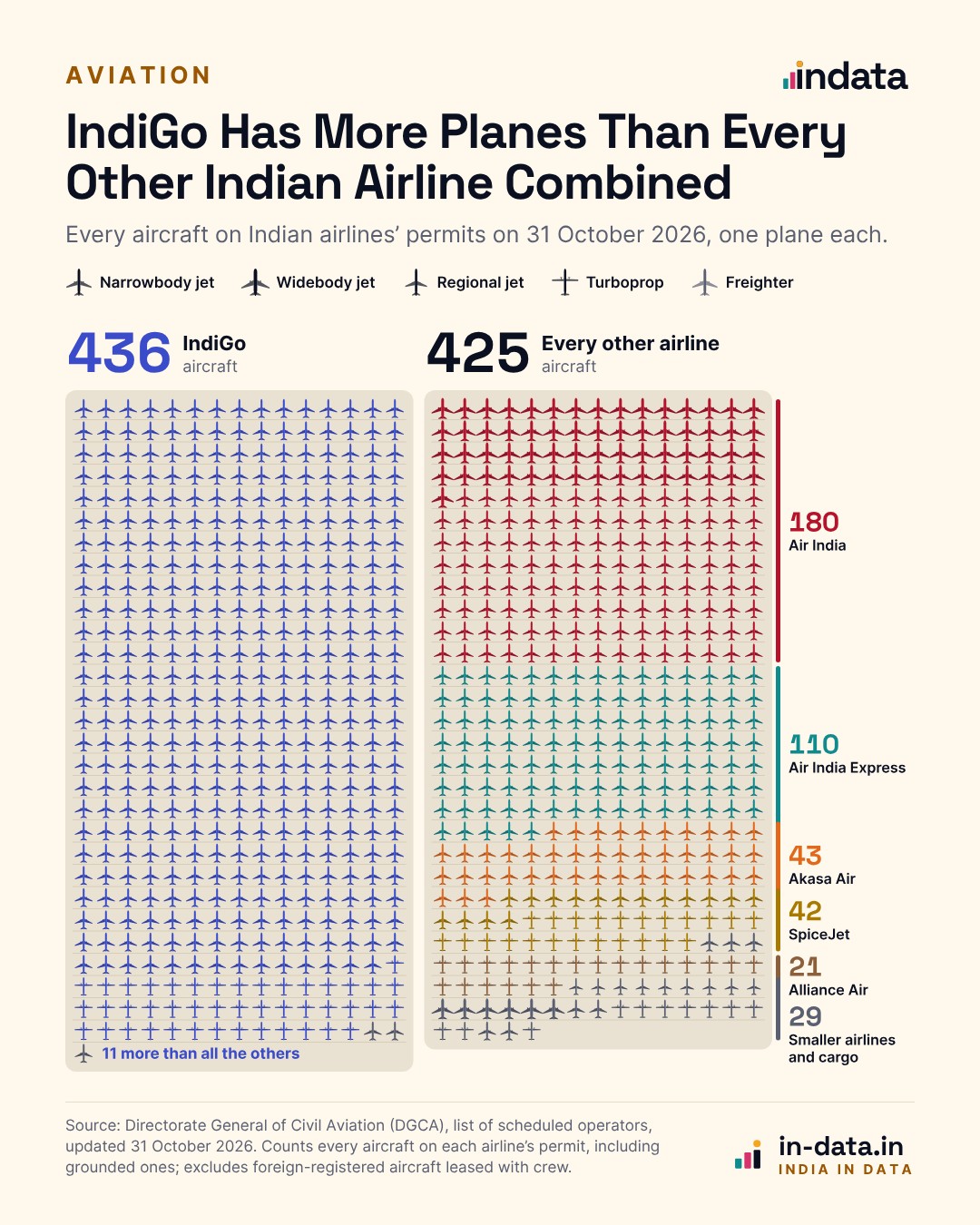
This graphic shows every aircraft registered to India’s scheduled airlines, with the IndiGo fleet on one side and all other airlines on the other.
Key takeawayLine up every airliner in India, and more than half of them are IndiGo’s.
India’s aviation market has been taking off. Airlines carried 16.7 crore domestic passengers in 2025, about twice as many as in 2015. With more passengers flying, the fleet of aircraft on the runways has also soared, up from about 400 in 2014 to 861 today.
However, just one airline—IndiGo—accounts for more than half of all the aircraft flown by India’s airlines. This graphic compares the IndiGo fleet with that of every other airline combined, based on data from the Directorate General of Civil Aviation (DGCA) as of October 2026.
Which Indian Airlines Have the Biggest Fleets?
The table below lists the number of aircraft registered to each airline, and each airline’s share of the national total.
| Airline | Aircraft | Share of all aircraft |
|---|---|---|
| IndiGo | 436 | 50.6% |
| Air India | 180 | 20.9% |
| Air India Express | 110 | 12.8% |
| Akasa Air | 43 | 5.0% |
| SpiceJet | 42 | 4.9% |
| Alliance Air | 21 | 2.4% |
| Smaller airlines and cargo | 29 | 3.4% |
In other words, IndiGo alone has 436 aircraft, while all the others put together have 425. Even Air India and Air India Express, which belong to the same group, add up to 290 aircraft, about two-thirds of IndiGo’s count.
The last row covers six small operators: the regional airlines Star Air, Fly91, IndiaOne Air and Skyhop, and the cargo carriers Blue Dart and Quikjet.
What the IndiGo Fleet Is Built For
The kind of aircraft matters as much as the number. Almost all of IndiGo’s fleet, 389 aircraft, are narrow-body jets from the Airbus A320 family. These are single-aisle planes built for short and medium flights, which is what most flying within India is. The rest are 44 small ATR turboprops for regional routes and 3 freighters.
Air India, however, is built differently. All 61 wide-body jets on the Indian register are Air India’s. Wide-body jets are the larger twin-aisle planes used for long international flights, so a big part of its fleet spends its time abroad.
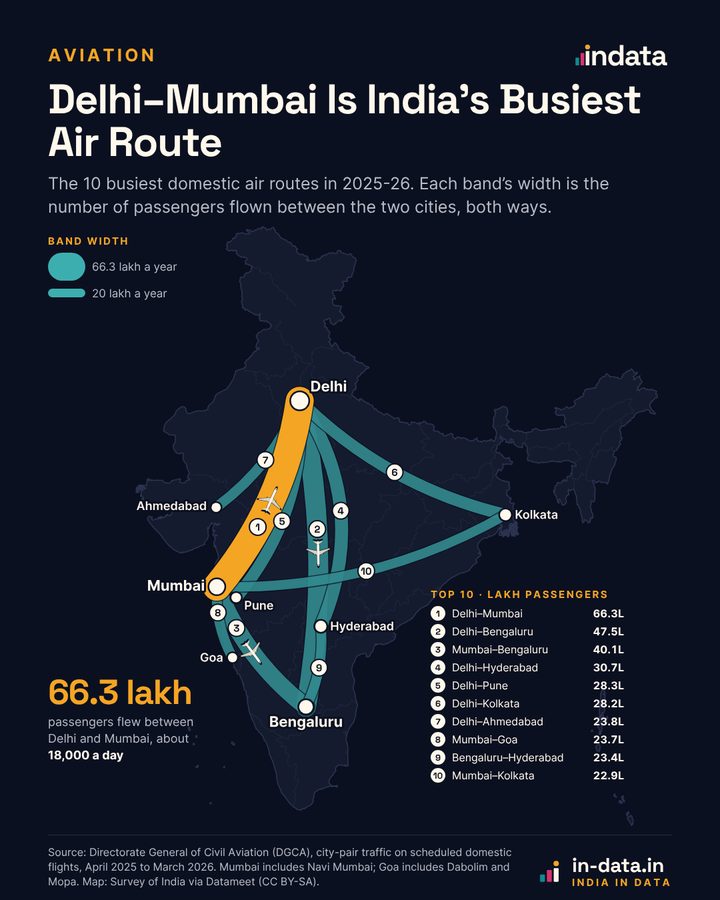
As a result, IndiGo’s lead in the air is even bigger than its lead on the ground. It carried 65.4% of India’s domestic passengers in September 2026, according to the DGCA, well above its 50.6% share of aircraft. If you’ve flown one of India’s busiest air routes lately, the odds are you flew IndiGo.
SpiceJet shows the opposite. It still has 42 aircraft on its permit, yet it carried just 0.6% of domestic passengers in September. The permit count includes planes that are grounded, which explains much of that gap.
Source and Method
Aircraft counts are from the DGCA’s List of Scheduled and Scheduled Commuter Operators, updated 31 October 2026. They cover every aircraft on each airline’s permit, including any that are grounded or in maintenance.
The list covers Indian-registered aircraft only. Therefore, it leaves out foreign-registered planes that an airline leases along with their crew, such as the Boeing 787s IndiGo uses on some international routes. IndiGo’s own count, which includes those, was 442 aircraft at the end of September 2026. Passenger shares are from the DGCA’s domestic traffic report for September 2026, and yearly passenger totals are from its reports for 2015 and 2025.