Coffee Production in India, by Region
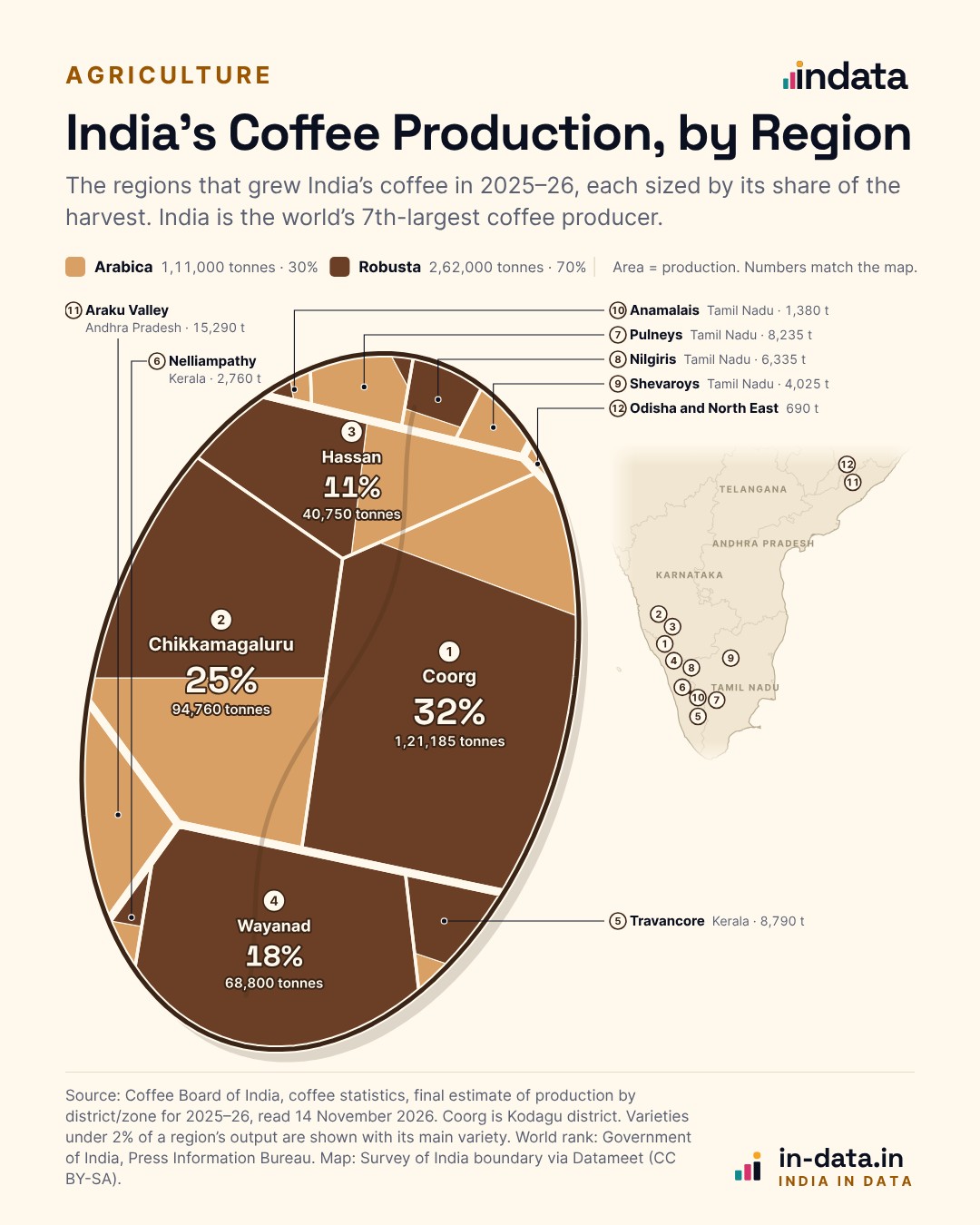
See coffee production in India by growing region, drawn as a single bean: each region is sized by its share of the 2025–26 harvest.
Key takeawayCoorg, one district in Karnataka, grows almost a third of India’s coffee.
India grew 3.73 lakh tonnes of coffee in 2025–26. Nearly all of it came from the hills of three southern states, and almost a third from a single district.
This graphic draws that harvest as one coffee bean. Each cell is a growing region, sized by how much coffee it produced, and shaded by variety: light for arabica, dark for robusta.
Coffee Production in India, by Region
One district dominates. Coorg, officially Kodagu district in Karnataka, grew 1,21,185 tonnes, almost a third of India’s coffee. Add its neighbours Chikkamagaluru and Hassan, and three Karnataka districts account for 68.8% of the national harvest. Wayanad in Kerala is the only other region above 10%.
| Region | State | Arabica | Robusta | Total | Share of India |
|---|---|---|---|---|---|
| Coorg (Kodagu) | Karnataka | 20,060 | 1,01,125 | 1,21,185 | 32.5% |
| Chikkamagaluru | Karnataka | 41,185 | 53,575 | 94,760 | 25.4% |
| Wayanad | Kerala | 0 | 68,800 | 68,800 | 18.4% |
| Hassan | Karnataka | 17,900 | 22,850 | 40,750 | 10.9% |
| Araku Valley | Andhra Pradesh | 15,240 | 50 | 15,290 | 4.1% |
| Travancore | Kerala | 940 | 7,850 | 8,790 | 2.4% |
| Pulneys | Tamil Nadu | 7,695 | 540 | 8,235 | 2.2% |
| Nilgiris | Tamil Nadu | 1,400 | 4,935 | 6,335 | 1.7% |
| Shevaroys | Tamil Nadu | 4,000 | 25 | 4,025 | 1.1% |
| Nelliampathy | Kerala | 1,135 | 1,625 | 2,760 | 0.7% |
| Anamalais | Tamil Nadu | 850 | 530 | 1,380 | 0.4% |
| Odisha | 470 | 0 | 470 | 0.1% | |
| North Eastern Region | 125 | 95 | 220 | 0.1% |
By variety, robusta is the bigger crop: 2,62,000 tonnes, or 70% of the harvest, against 1,11,000 tonnes of arabica. That split matters for everything that follows.
A growing crop that mostly leaves the country
India’s coffee harvest has been rising. The Coffee Board recorded 3.05 lakh tonnes in 2013–14 and 3.60 lakh tonnes in 2023–24. The 3.73 lakh tonnes of 2025–26 is about 22% more than twelve years earlier, and the board’s early estimate for 2026–27 is higher still, at 4.04 lakh tonnes.
Indians are drinking more coffee too, but slowly. A study for the Coffee Board put domestic consumption at 91,000 tonnes in 2023, up from 84,000 tonnes in 2012. That is growth of about 1% a year, helped by instant coffee, rising incomes and café culture in cities.
Set those two numbers side by side and the gap is plain: India grows roughly four times the coffee it drinks. The rest is sold abroad. About 70% of the crop is exported, to 128 countries, and export earnings reached a record 1.8 billion US dollars in 2024–25. The momentum has continued: in the first four months of 2026, shipments rose 26% to 1.74 lakh tonnes, led by robusta.
Why a drought in Brazil reaches Coorg
A country that exports most of its coffee lives by the world price, and the world price moves with Brazil’s harvest. Brazil grows 35% of the world’s coffee, more than the next three countries combined. India, in seventh place, grows 3.6%.
In August and September 2024, Brazil had what the Financial Times called its worst drought in 70 years, shortly before the next crop flowered. Vietnam, the largest grower of robusta, was in its third straight year of short supply. Prices followed. Arabica futures hit a record 3.48 dollars a pound in December 2024, after rising about 80% in a year, and robusta reached its highest level in 47 years.
This is where India’s 70% robusta comes in. Roasters can swap some arabica for robusta when arabica gets expensive, so a shortage of one lifts demand for the other. India is the world’s fifth-largest robusta producer, after Vietnam, Brazil, Indonesia and Uganda. Its record export earnings came in that year of record prices, and the rise in shipments since has been led by robusta.
The cycle has now turned. Brazil is heading for a record harvest, and by May 2026 arabica had fallen to an 18-month low of 2.73 dollars a pound. India’s growers now face lower prices, with a larger crop on the way.
Who grows it, and why here
Those growers are overwhelmingly small. The Coffee Board counts 4,42,753 coffee farms in India, and 99.4% of them are smaller than 10 hectares.
They are in the southern hills because of climate and history. Arabica grows in the cooler highlands and robusta in warmer, humid areas, and Indian coffee is grown under two tiers of shade trees across the Western and Eastern Ghats. By legend it began in Chikkamagaluru, where the Sufi saint Baba Budan planted seven seeds from Yemen around 1600. Chikkamagaluru is still India’s second-largest coffee region.
For another state-by-state view of India, see the best-selling car brand in every state.
Source and method
Coffee Board of India, coffee statistics: production in major states and districts, final estimate for 2025–26, by variety, and number of holdings by size for 2024–25, read on 14 November 2026. Two production figures on that page contain typing errors (robusta for Kodagu and for Travancore); we used the values that agree with each row’s total and the state subtotals. Earlier years’ production is from the Coffee Board’s Database on Coffee, July 2024. The bean’s cells are drawn so that each one’s area equals its share of production. On the graphic, a variety that makes up less than 2% of a region’s output is merged with that region’s main variety, and Odisha and the North Eastern Region share one cell; the table lists them separately. World shares are from the United States Department of Agriculture for 2025/26; its estimate of India’s crop differs slightly from the Coffee Board’s. The link between world prices and India’s exports is our reading of these sources, not a finding of any one of them. Shares are rounded to one decimal place.