Petrol Price Breakdown: Where ₹102 for a Litre Goes
See the petrol price breakdown for one litre in Delhi: how much goes to the oil company, the petrol pump, the central government and the state.
Key takeawayMore than a quarter of what you pay for petrol in Delhi is tax.
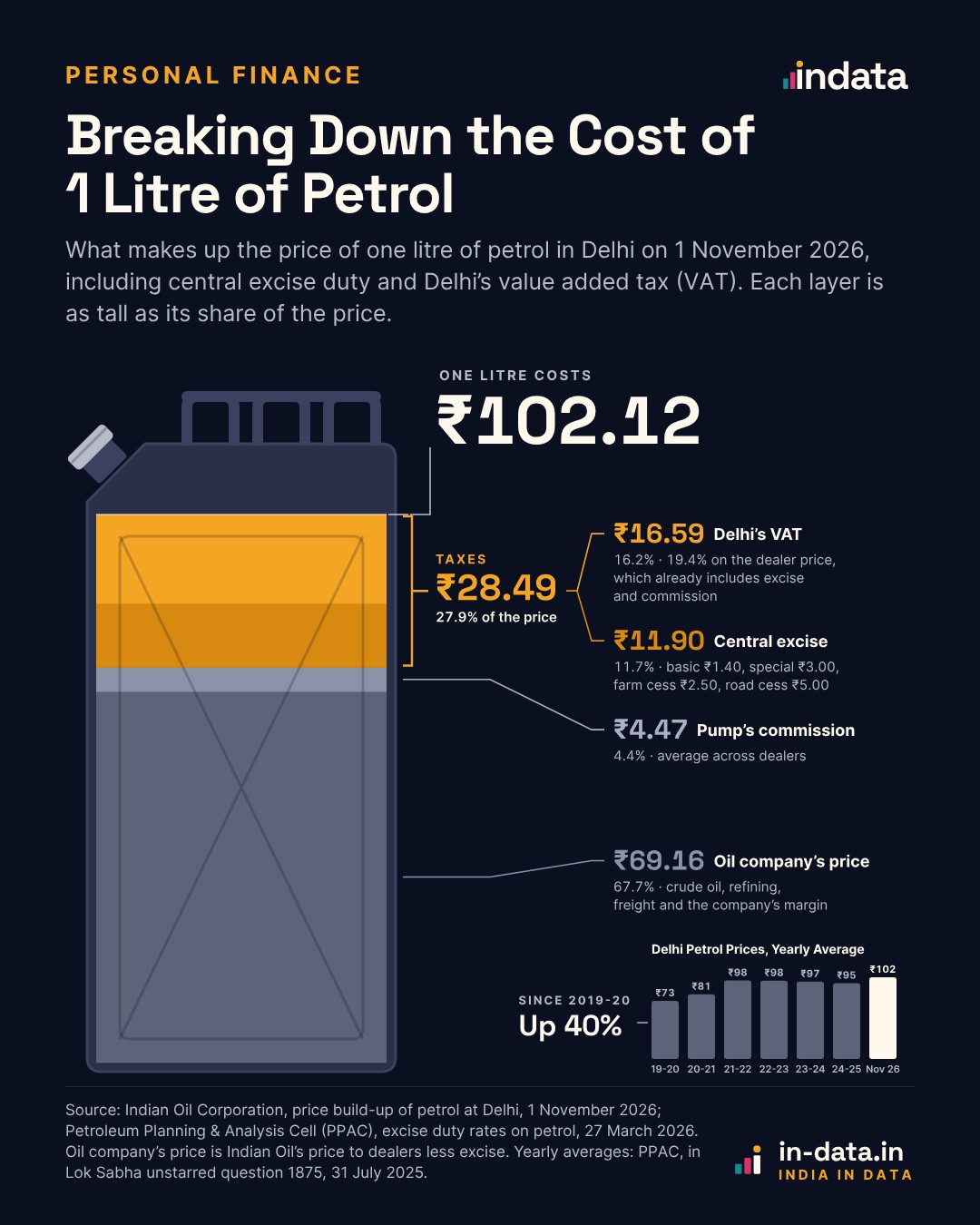
The price on the pump is not one number. It is four amounts stacked on top of each other: what the oil company charges, what the petrol pump keeps, a tax that goes to the central government and a tax that goes to the state.
On 1 November 2026 a litre of petrol in Delhi cost ₹102.12. This graphic pours that litre into a can, one layer at a time, using Indian Oil Corporation’s own price build-up.
Petrol Price Breakdown in Delhi
About two-thirds of the price is the fuel itself: crude oil, refining, freight and the oil company’s margin. Taxes are the next biggest part: ₹28.49 of every litre, or 27.9% of what you pay.
| Component | Amount per litre | Share of price | Who gets it |
|---|---|---|---|
| Oil company’s price | ₹69.16 | 67.7% | Oil company |
| Pump’s commission | ₹4.47 | 4.4% | Pump dealer |
| Central excise duty | ₹11.90 | 11.7% | Centre |
| Value added tax (VAT) | ₹16.59 | 16.2% | Delhi |
| Price at the pump | ₹102.12 | 100% |
The pump itself keeps the smallest slice: ₹4.47, less than a twentieth of the price.
Why the tax is the size it is
The central tax is a fixed amount. Excise duty is charged in rupees per litre, not as a percentage, so it stays the same whether crude oil is cheap or expensive. The ₹11.90 is four charges added together: a basic duty of ₹1.40, a special additional duty of ₹3.00, a farm cess of ₹2.50 and a road cess of ₹5.00.
It was cut in March. On 27 March 2026 the central government lowered excise duty on petrol by ₹10 a litre. The finance minister said the move would protect consumers from rising prices during the West Asia crisis.
The state tax is a percentage, charged on top of the central tax. Delhi charges 19.4% VAT on a price that already includes excise duty and the pump’s commission. That is ₹85.53, and 19.4% of it is the ₹16.59 in the can. Because it is a percentage, this tax rises whenever the price of fuel does.
Your city will differ. Each state sets its own rate. The government’s table of state fuel taxes lists 19.4% for Delhi, 25% plus ₹5.12 a litre for Mumbai, and 35.2% for Telangana. The central excise duty is the same everywhere, so state tax is one reason pump prices differ from city to city.
How the price has moved
Petrol in Delhi averaged ₹72.69 a litre in the year from April 2019 to March 2020. By 2021-22 the yearly average had reached ₹98.05, and it stayed between ₹94 and ₹98 for the next three years. Today’s ₹102.12 is 40% above the 2019-20 average.
Fuel is also part of how inflation is measured. See how transport and fuel are weighted in India’s inflation basket.
Source and method
Indian Oil Corporation, price build-up of petrol at Delhi, effective 1 November 2026, which gives the price charged to dealers (₹81.06), the dealer commission, VAT and the retail price. The build-up does not show excise duty separately, so the oil company’s price is the price to dealers less the ₹11.90 excise duty in the Petroleum Planning and Analysis Cell (PPAC) tariff table posted on 27 March 2026. Delhi’s pump price was still ₹102.12 on 12 November 2026. Yearly averages are from PPAC data given in reply to Lok Sabha unstarred question 1875, 31 July 2025. State tax rates are from PPAC’s table as updated on 12 November 2026. Shares are rounded to one decimal place.